

What the 23 June 2026 ministerial response really changes
For years, working remotely from France on a long-stay “visitor” visa lived in a grey area: the visitor undertakes not to work in France, yet consulates granted the visa to people who did not work for the French market. At the same time, the consequences of carrying out an undeclared professional activity in France, even remotely, can be disastrous.
Legal practitioners had no clear position from the administration on the point.
On 23 June 2026, the French Ministry of the Interior finally took a written position: on the immigration front, the stance of the administration, and therefore of consulates and prefectures, is now clarified (answer to written question no. 11730).
However, this opening for remote work on a visitor visa is conditional, temporary by nature, and could lead foreign nationals to make serious mistakes in other areas of law (notably tax, labor and social security law).
Here is our analysis, with sources, including a recent social security decision that illustrates the position of the CPAM on this issue.
The scope of this clarification: an answer given by the executive
Before turning to the substance, this ministerial response must be placed in legal context. It is neither a law, nor a decree, nor a court decision. It is a ministerial answer to a written parliamentary question: a member of parliament questioned the Government, and the Ministry of the Interior replied. We are therefore facing a position of the executive, expressed as administrative doctrine. In principle, such a response has only informative value: it creates no right, does not bind the courts, and does not bind the other administrations, in particular Urssaf or the tax administration, which keep their own reading. It usefully sheds light on how the Ministry reasons on residence law, but it remains a soft text, liable to change, and lacking the certainty a law or a ruling would offer.
The clarification: for immigration, remote work for a foreign employer is accepted
Asked through a written parliamentary question (QE no. 11730, answer published in the Official Journal on 23 June 2026), the Ministry of the Interior adopts the following reasoning: a foreign national who works remotely from France for an employer governed by foreign law, without being employed in France or working for a company located in the territory, must be “considered non-active under French law.” Not being active in immigration terms, they do not need a work permit: they fall precisely under the “visitor” residence card.
To our knowledge, this is the first time the Ministry of the Interior has confirmed in writing what consulates and certain prefectures were already doing. The logic is protection of the French labor market: as long as the activity is not integrated into the French economy, it does not breach the undertaking, set out in Article L426-20 of the CESEDA, not to work in France. In practice, for this specific profile, the visitor visa now works like a digital nomad visa that dares not speak its name.
In a similar situation, or considering it? Talk to us before you settle in France.
Remote work on a visitor visa? Yes, but… the conditions and blind spots
The response does not say anything goes. It sets conditions, and it leaves untouched questions that are not the Ministry of the Interior’s to decide.
The exact scope of what is allowed
Remote work on a visitor visa is admitted where the foreign national works remotely for an employer governed by foreign law, carries out no professional activity in France, whether as an employee or for the benefit of a company located in France, remains paid in their country of origin and pays the related tax in that country. The last two conditions are not incidental: the Ministry of the Interior bases its “non-active” qualification on the assumption that the person pays tax elsewhere.
What remains prohibited, in every scenario, is carrying out in France a professional activity “subject to authorization,” meaning any activity integrated into the French market, for a French employer or French clients. A freelancer soliciting French clients, or someone selling products or services into the French market, falls outside the frame. In our view, a person selling goods or services online cannot benefit from this regime, because they must register in France, unless they can prove that no client on the French market buys their products, which is difficult. The risk is not merely theoretical: Article L8221-3 of the French Labor Code treats as concealed work the pursuit of a lucrative activity by a person who intentionally fails to register when registration is mandatory, or fails to make the declarations due to social or tax authorities.
Need to know whether your activity fits this scope? We assess your specific situation.
Blind spot 1: tax law caps the arrangement in time
The ministerial response states that the foreign national must apply for a visitor visa when they reside in France but “remain paid and pay the related tax in their country of origin.”
This condition is the scheme’s Achilles heel, and can lead to serious mistakes in other areas of law.
Indeed, one must assess in advance whether the foreign national will be a French tax resident. They may be, not only after six months of presence on the territory, but potentially from arrival if, for example, their household, meaning the family home, is in France. The very condition set by the Ministry of the Interior then becomes untenable for a stay that lasts. In other words, before applying for a visitor visa to work remotely from France, the foreign national’s situation must be checked upfront on the tax side, and the authorization is only viable, in our view, as an exceptional, transitional solution.
This is without even mentioning the risk, for a foreign employer that lets its employee work remotely from France, of unknowingly creating a permanent establishment taxable in France. That risk could materialize, for example, where the foreign national working remotely from France holds a management position there.
These considerations are part of the overall immigration strategy we build for our clients, and should not be improvised: other visas and residence permits exist precisely to cover these situations and genuinely integrate the foreign national into France.
Blind spot 2: the foreign employer’s duty to register in France (Urssaf Firmes Étrangères)
The Ministry of the Interior does not analyze labor law or social security law, and for good reason: it has no authority over them. Yet a person physically working in France is in principle subject to French social security. Being “non-active” under immigration law does not make the person non-active under social security law or vis-a-vis Urssaf. An undeclared activity physically carried out from French territory can be characterized as “concealed,” and give rise to reassessment or even significant penalties, applicable both to the foreign national and to the foreign company that employs them, even without an establishment in France.
The risk is, moreover, criminally defined. Where an employer employs a worker in France without filing the pre-hiring declaration or the mandatory social declarations, it commits concealed work by concealment of salaried employment (Article L8221-5 of the Labor Code). A foreign employer whose employee works remotely from France, without registering with the Urssaf Service Firmes Étrangères or paying contributions, falls within this scope: the failure to declare is not a mere administrative irregularity.
We saw this first-hand. A US citizen living in the south of France, employed remotely by a company based in the United States, came to us after running into a refusal of social security affiliation. Believing she was compliant (salary paid abroad, no French clients), she had applied for French health coverage as an inactive resident. The fund refused: in its view she carries out salaried work for a US company, so she is active, and it is up to her employer to register and pay contributions in France. The fund cites Article L243-1-2 of the Social Security Code and points to the Urssaf Service Firmes Étrangères; failing that, it tells her to take out private insurance. It was with this letter in hand, reproduced below, that she contacted us.
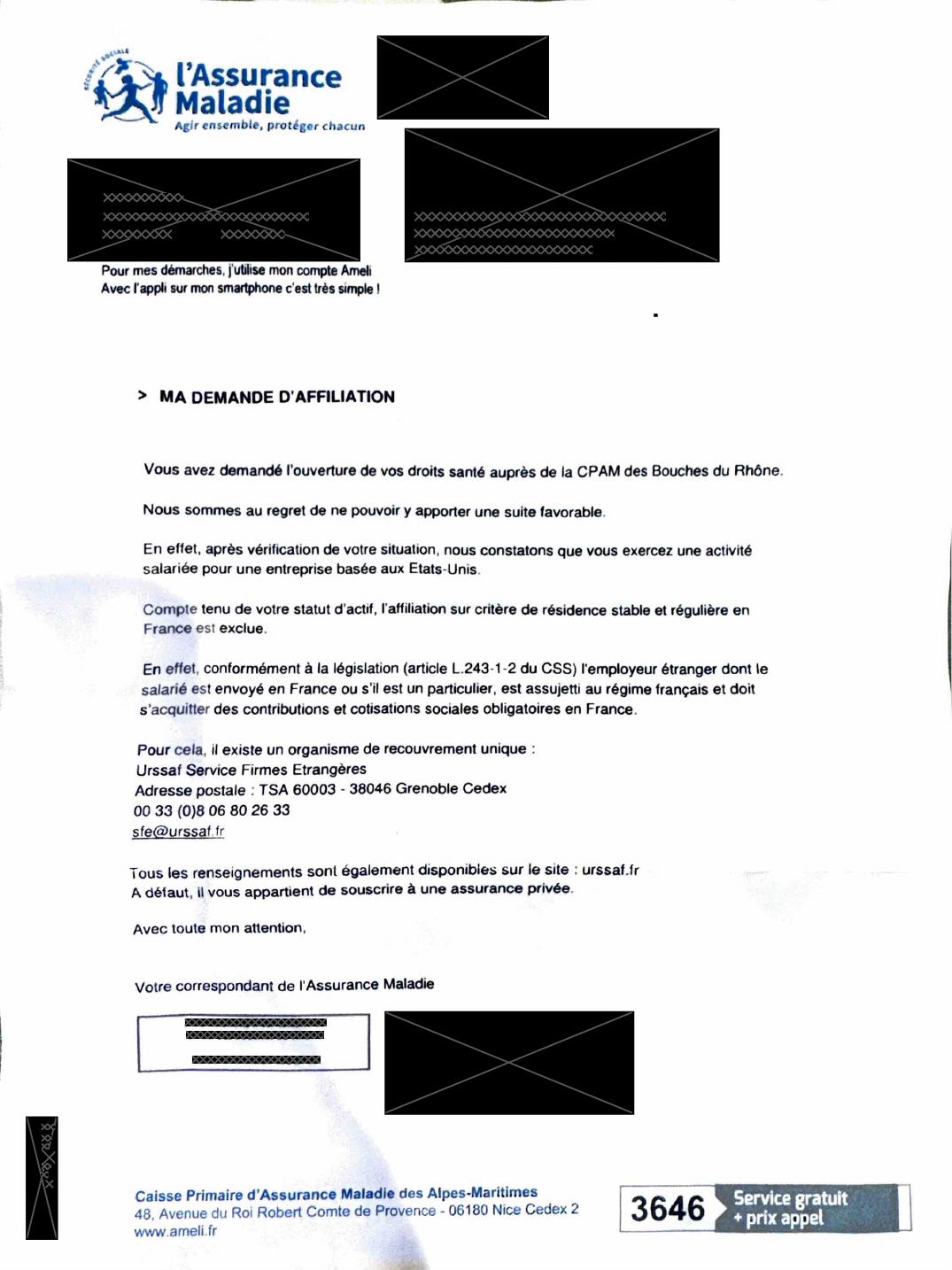
The contrast is striking: where the Ministry of the Interior would qualify this person as “non-active,” the fund treats the same person as “active.” Neither administration is wrong in its own field; they simply are not talking about the same thing. And it is the foreign national caught in between.
Blind spot 3: citizenship stays closed
Finally, this response leaves aside the question of naturalization. The circular of 2 May 2025 on the acquisition of French nationality (NOR INTK2513256J) instructs prefects to set aside, save exceptions, “applications from applicants whose income comes mainly from abroad, since this situation shows that they have not fully transferred the center of their interests to France.” It also requires professional integration in France assessed over five years. A remote worker who, in good faith, was paid entirely abroad for years meets exactly the refusal criteria: foreign-source income and no French professional integration.
Blind spot 4: regulated professions, an aggravated risk
There is one case where this clarification brings no comfort and even makes things worse: regulated professions (lawyer, doctor, psychologist, chartered accountant, architect, real estate agent, and so on). Practising a regulated profession from French soil means carrying out an activity “subject to authorization” in the very sense of the ministerial response, regardless of where the clients are. The “non-active” fiction does not switch off the rules governing the profession: protected title, registration with a professional body or register, and sometimes an authorization conditional on a treaty.
The foreign lawyer is a telling example. A lawyer admitted to a bar outside the European Union may practise from France as a “foreign legal consultant” only if a treaty between their State and the European Union so provides; they then need authorization from the Conseil national des barreaux and registration with a French bar (Article 101 of Law no. 71-1130 of 31 December 1971). Without a treaty, practising from France is simply closed, even for foreign or international law and even for foreign clients.
The same logic applies, to varying degrees, to psychologists (protected title, Article 44 of Law no. 85-772 of 25 July 1985, registration on the professional register), doctors, accountants and architects. For these professionals, “working remotely from France” is not just one more blind spot: it is often an impossibility until they have complied with the relevant French professional body, which the visitor visa does not allow.
So, should you use the visitor visa to work remotely?
Yes, but as a bridge, not a destination. For a short stay, during a transition, and for someone planning neither long-term settlement nor naturalization, the ministerial response brings welcome certainty on the immigration side, provided the foreign national has checked upfront the absence of French tax liability, which may arise from the very first day on the territory.
For a life project in France, the response leads to a dead end: as soon as you become a tax resident, the condition is no longer met, Urssaf catches up with you, and citizenship slips away.
The real long-term fix would be for France to create a genuine digital nomad visa, like Spain and Portugal, clarifying social and tax obligations from the outset for foreign nationals working remotely from France.
Until then, the right choice depends on your situation: do you work for an employer, or for yourself? Do you wish to obtain French nationality in time?
- Posting, ICT or employee on assignment (a transitional solution): if you remain a foreign employer’s employee, that employer can post you to France, on a mission or through an intra-company transfer (ICT). These permits formalize your presence and, under a bilateral agreement, can keep you in your home social security scheme. They are a bridge: temporary by nature, they do not build the residence required for naturalization, because the center of your interests remains deemed to be abroad.
- The permit authorizing durable work (the settlement route): to settle and work durably in France for an employer, aim for a permit that opens a long-term perspective (Talent residence permit, EU Blue Card, or a local employment contract with a work authorization), with the employer then declared in France. You are fully covered and, in time, eligible for naturalization.
- The entrepreneur / project-based talent visa: if you work for yourself, apply for an entrepreneur/liberal profession permit, with social security affiliation in France. You can, of course, invoice your foreign clients from France, and you will then be compliant and far better positioned to obtain your naturalization, because your activity is registered, contributing and taxed in France.
FAQ
Does the ministerial response officially authorize remote work on a visitor visa?
It clarifies the Ministry of the Interior’s position: a remote worker for a foreign employer is considered non-active and may fall under the visitor card. This is administrative doctrine, not law. It expresses the position of the residence administration (consulates, prefectures), but binds neither the courts, nor Urssaf, nor the tax administration.
Can I stay on a visitor visa working remotely long term?
Hardly. The benefit assumes you remain paid and taxed abroad, which becomes impossible once you are a French tax resident (after 183 days at the latest, sometimes from arrival). Long term, it is not the right solution.
Will I have French social security?
It depends on your situation. If you are inactive, you are in principle entitled to French health cover after three months of legal residence. However, if you work remotely for a foreign employer, the fund treats you as active. Affiliation then requires your foreign employer to register in France through the Urssaf Service Firmes Étrangères. Otherwise, you need private insurance.
Does remote work on a visitor visa lead to French citizenship?
In practice, hardly. The 2 May 2025 circular leads to setting aside applications whose income comes mainly from abroad and requires French professional integration.
What if I sell online, for example on a crafts platform?
This is delicate, even outside the frame and inadvisable. The response targets an employee of a foreign employer. Selling your own products is an independent activity, and if French clients buy your products, you contribute to the French market, which the visitor visa does not allow. The entrepreneur visa is then the right route.
Conclusion
The 23 June 2026 response is a first clarification, and we welcome it. But it does not completely turn the visitor visa into a digital nomad visa: it secures immigration for a narrow profile and a limited time, while leaving social security, tax, citizenship and regulated professions entirely unresolved. On reflection, it opens a narrow door on the immigration side alone while multiplying the risk areas: for many profiles, it raises more risks than it offers opportunities, and it makes case-by-case analysis more necessary than ever. Our role is precisely to spare you unpleasant surprises and to build, with you, a global, long-term immigration strategy.
Need Legal Assistance in France?
Yuliana Colorado, avocate at the Paris and Madrid bars, works in English, French and Spanish. Get guidance on your own situation.

